“V-P Jagdeep Dhankhar’s critique on the use of Article 142 is something I strongly disagree with. According to a Congress Rajya Sabha MP, Dr. Ambedkar and the framers believed it was appropriate to entrust our Supreme Court and the Supreme Court alone with this unique authority.
Below is a rewritten version of the provided article, maintaining the core content and context while rephrasing for clarity, conciseness, and neutrality. The structure remains similar, focusing on Abhishek Manu Singhvi’s arguments regarding the Waqf (Amendment) Act, the National Herald case, and Vice President Jagdeep Dhankhar’s criticism of the judiciary.
Abhishek Manu Singhvi on Waqf Act, National Herald Case, and Judicial Criticism
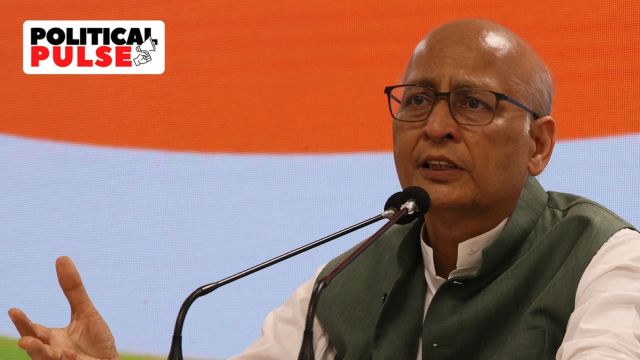
Congress Rajya Sabha MP and senior advocate Abhishek Manu Singhvi, one of the lead counsels challenging the Waqf (Amendment) Act, 2025, in the Supreme Court, recently discussed the case, the National Herald charge sheet against Congress leaders Sonia Gandhi and Rahul Gandhi, and Vice President Jagdeep Dhankhar’s remarks on the judiciary.
Waqf (Amendment) Act: Supreme Court’s Interim Order
The Supreme Court issued an interim order on petitions challenging the Waqf (Amendment) Act, prompting the government to pause key provisions until May 5, 2025. Speaking cautiously as a counsel in this sub judice matter, Singhvi described the order as significant, noting that stays on newly enacted laws are rare. After two days of hearings spanning nearly two and a half hours, the Court stayed three critical provisions, which Singhvi called the “heart and soul” of the Act. He dismissed claims that petitioners seek a blanket stay on the entire Act, accusing the government of misrepresenting the legal challenge.
Hope for Further Relief?
Singhvi clarified that petitioners are not seeking a stay on the entire Waqf (Amendment) Act, labeling such suggestions as deliberate misinformation. Instead, they aim to address specific provisions, particularly sections 3C(2) proviso, 36(7a), and 36(10). These sections, he argued, create an “absurd situation” by:
- Allowing Collectors to declare disputes over Waqf properties.
- Treating disputed Waqf properties as non-Waqf during pendency.
- Imposing no time limit for Collectors to resolve disputes.
- Blocking Waqf registration while disputes are unresolved.
- Barring court access due to non-registration caused by pending disputes.
Singhvi expressed confidence that the Supreme Court will address these issues in the next hearing, alongside other problematic provisions. He emphasized that the challenge is selective, not a blanket opposition to the Act, countering narratives that mischaracterize the petitioners’ stance.
National Herald Case: Questioning Legality and Intent
Regarding the National Herald case, where Congress leaders Sonia Gandhi and Rahul Gandhi face a charge sheet, Singhvi questioned the case’s political, legal, media, and psychological dimensions. He argued that the case lacks legal merit, particularly in relation to money laundering allegations. Singhvi highlighted two key points:
- No Crime Committed: Assigning a debt to a Section 8 (not-for-profit) company is not a crime, and no money or property has been transferred.
- No Proceeds of Crime: Without any movement of funds or assets, the essential element of proceeds of crime is absent.
Singhvi’s remarks suggest a broader critique of the case’s timing and motives, though he emphasized the legal flaws in the allegations.
Context and Implications
Singhvi’s statements reflect his dual role as a legal strategist and political figure. On the Waqf Act, he seeks targeted judicial intervention to protect minority rights while refuting exaggerated claims of seeking a total stay. In the National Herald case, he challenges the legal foundation of the charges, framing them as politically motivated. Additionally, Singhvi has defended the judiciary’s use of Article 142 against Vice President Dhankhar’s criticism, arguing it is essential to check executive overreach, particularly by Governors acting as Central government proxies.
As the Supreme Court continues to hear the Waqf Act petitions and the National Herald case progresses, Singhvi’s arguments underscore the intersection of law, politics, and constitutional principles in these high-stakes disputes.
This rewritten version condenses the original text, clarifies legal arguments, and adopts a neutral tone while preserving Singhvi’s core positions. Let me know if you need further refinements or additional details!