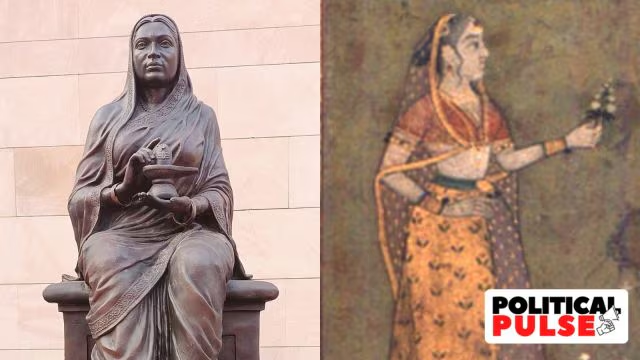
Among individuals honored by the Sangh are Ahilyabai Holkar, Rani Durgawati, and Rani Abbakka, whose greatest accomplishments are “defeating invaders” and “protecting Hinduism.”
As women have become a significant electoral constituency, with all political parties seeking their votes, the RSS has also increasingly embraced the celebration of womanhood by integrating its ideology with female leadership. In recent years, the organisation has highlighted the birth anniversaries of women rulers from medieval India who fought against the Mughals or Western imperial powers.
The RSS has commemorated figures such as Ahilyabai Holkar, Rani Durgawati, and Rani Abbakka, all of whom are recognised for their resistance against foreign rulers. Holkar and Durgawati were known for their battles against Muslim rulers, while Abbakka fought against the Portuguese. These rulers hold special significance for the Sangh due to their role in safeguarding Hindu traditions.
At a recent meeting of the Akhil Bharatiya Pratinidhi Sabha (ABPS), the highest decision-making body of the RSS, Sangh Sarkaryawah (General Secretary) Dattatreya Hosabale made a statement marking the 500th birth anniversary of Rani Abbakka. He described her as a great freedom fighter, a master administrator, and an invincible strategist, highlighting her efforts in promoting religious inclusivity and development. Abbakka, a Tuluva queen of Ullal from the Chowta dynasty, led a strong resistance against Portuguese forces in the 16th century.
Last year, the RSS launched year-long celebrations for the 500th birth anniversary of Rani Durgawati, a Rajput princess who married into the Gond tribal community. She is remembered for her courageous resistance against Mughal emperor Akbar. According to RSS affiliates, Durgawati successfully defended her kingdom three times before ultimately taking her own life after her forces were defeated in an open battle. Her sacrifice is commemorated as Balidan Diwas.
Similarly, in the run-up to the last Lok Sabha elections, the RSS organised a year-long celebration of Ahilyabai Holkar’s 300th birth anniversary. Born in 1725, Holkar became queen of the Malwa region under Maratha rule in 1767. She is often hailed as a feminist icon who promoted women’s education and empowerment, and her reign is remembered as a prosperous period for central India. Holkar’s historical importance also ties into the Sangh’s temple politics, as she was instrumental in renovating several temples, including the Kashi Vishwanath temple, which is currently at the center of a legal dispute concerning the Gyanvapi mosque.
An RSS functionary clarified that these commemorations were not solely about celebrating womanhood but also about honouring “unsung heroes” who resisted foreign invaders. The functionary pointed out that the historical narrative of medieval India is often dominated by the Mughals, and the RSS aims to popularise the contributions of Indian rulers who fought against them. The organisation has previously celebrated the anniversary of figures such as Lachit Borphukan, the Assamese general who defeated the Mughals.
This development also aligns with the Sangh’s recent efforts to counter criticism that it is a male-dominated organisation. In 2022, for the first time, the RSS invited a woman, mountaineer Santosh Yadav, as the chief guest at its annual Dussehra celebrations. This decision followed remarks by General Secretary Dattatreya Hosabale acknowledging the need for greater female participation within the organisation.