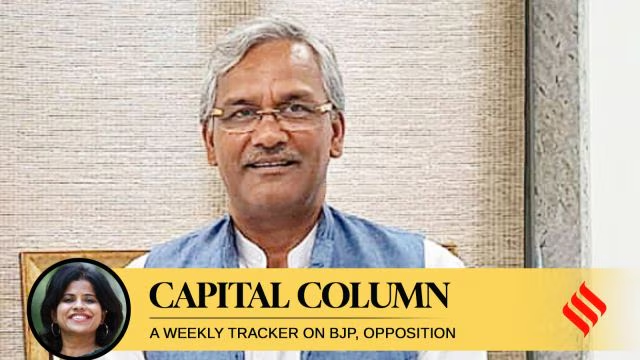
The allegations of “rampant illegal mining” in Uttarakhand made by Haridwar MP Trivendra Singh Rawat on the floor of Parliament show that the divisions caused by dissent in the state are far from over.
As the BJP continues its winning streak while expanding its presence across the country, signs of internal discord have emerged in several states.
In Uttarakhand, former Chief Minister and Lok Sabha MP Trivendra Singh Rawat recently raised concerns in Parliament about what he described as “rampant” illegal mining in the state. Meanwhile, in Uttar Pradesh, the party issued a show cause notice to its Loni MLA, Nand Kishore Gurjar, for publicly criticizing the Yogi Adityanath government. In Karnataka, the BJP’s only southern stronghold, the party expelled MLA Basangouda Patil Yatnal after he repeatedly attacked former Chief Minister B S Yediyurappa and his son, state BJP chief B Y Vijayendra.
According to BJP leaders, one of the reasons for the increasing factionalism is the party’s strategy of inducting members from other political groups to strengthen its influence, particularly in states where it has a minor presence. Additionally, ongoing organizational restructuring at all levels has contributed to internal tensions.
The situation in Uttarakhand has been particularly striking, especially since Rawat chose Parliament as the platform to voice his allegations. A party leader remarked that it was unusual for a former chief minister to publicly accuse a BJP-ruled state of illegal activities while the Prime Minister and other central leaders were in power. Matters escalated further when Rawat directly confronted the state’s Mining Secretary, Brajesh Sant, who responded with a fact sheet refuting his claims. Rawat’s remark, “A lion does not hunt a dog,” was widely criticized as casteist, given that he belongs to the upper-caste Thakur community while Sant is a Dalit. The Uttarakhand IAS Association protested against Rawat’s comments, an action perceived as having the support of Chief Minister Pushkar Singh Dhami.
The BJP has a history of factionalism in Uttarakhand. In 2007, when the party returned to power, Maj Gen (retd) B C Khanduri was appointed Chief Minister but was replaced by Ramesh Pokhriyal Nishank in 2009, only for Khanduri to be reinstated in 2011, just five months before the Assembly elections. Rawat, who was made Chief Minister in 2017 after the BJP’s return to power, was removed a year before the next Assembly elections and replaced by Lok Sabha MP Tirath Singh Rawat. Within four months, Tirath Singh Rawat was also replaced by Dhami. The internal divisions within the party were again evident when Dhami lost his 2022 Assembly election from Khatima, a defeat attributed to infighting.
Despite his loss, Dhami was reinstated as Chief Minister, though critics argue that the BJP leadership is increasingly concerned about his emphasis on image-building rather than governance. A party MP remarked that Dhami frequently visits Delhi to maintain good relations with central leaders, while governance at the state level remains sluggish. Supporters of Dhami, however, suggest that Rawat’s accusations stem from concerns that corruption allegations against him may be revived, while rivals within the party are attempting to destabilize him.
In Uttar Pradesh, tensions are believed to be linked to the rivalry between Deputy Chief Minister Keshav Prasad Maurya and Yogi Adityanath. MLA Gurjar, a close ally of Maurya, has been outspoken in his criticism of the government, reflecting underlying divisions within the state BJP.
Meanwhile, in Karnataka, the central leadership’s expulsion of Yatnal is seen as a clear message for the state unit to unify behind Yediyurappa and Vijayendra. Yatnal, known for his hardline Hindutva stance, is reportedly considering launching a new party aimed at “protecting Hindus.”