As demonstrated by figures like Jawaharlal Nehru and Atal Behari Vajpayee, Indian politicians in the past were frequently the targets of jokes. Now that isn’t the case.
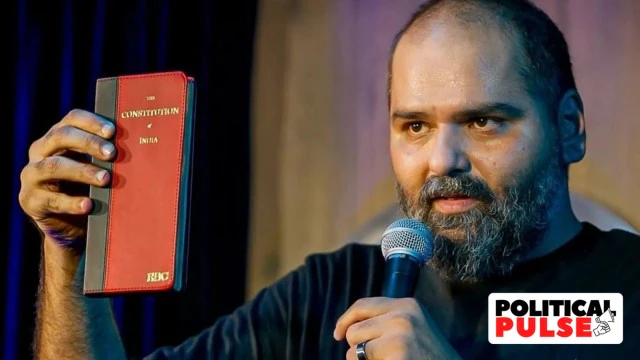
For nearly a week, comedian Kunal Kamra has been in the news for his reference to Maharashtra Deputy Chief Minister Eknath Shinde as a “gaddar” (traitor), which led to Shiv Sainiks vandalizing the studio where Kamra had performed. This incident has sparked discussions about the right to free speech, the tolerance levels of public figures today, and the appropriate way to address grievances.
Over the years, politicians of various ideologies, including Prime Ministers, have been the subject of satire. While criticism is rarely welcomed, it remains an essential aspect of democracy. As Prime Minister Narendra Modi recently stated in a podcast, “criticism is the soul of democracy.” Public figures must learn to endure it to maintain the essence of democratic discourse.
Among Indian Prime Ministers, Jawaharlal Nehru was perhaps the most tolerant of criticism. Aruna Asaf Ali recounted an instance when an MP accused Nehru of being a dictator. Nehru responded with humor, saying, “I hope I am not a dictator, but if I am, I must be a very bad one.” His remark highlighted that an MP openly making such an accusation indicated either that Nehru was not a dictator or an ineffective one. During the India-China War in 1962, when cartoonist R.K. Laxman published a satirical cartoon about him, Nehru called Laxman to express his amusement and even requested a signed, enlarged copy to frame.
Indira Gandhi, a powerful Prime Minister, often faced criticism. The Congress party frequently blamed America’s CIA for the country’s troubles. In response, Swatantra Party MP Piloo Mody, a vocal critic of the government, once entered Parliament wearing a placard that read, “I am a CIA agent,” mocking the accusations. This act elicited laughter from Indira Gandhi, according to witnesses.
Rajiv Gandhi, too, engaged in political humor. He once remarked that while Communists claimed to follow Karl Marx, they behaved more like followers of Groucho Marx, a famous comedian. Though this comment did not amuse the Communists, they accepted it in stride.
Atal Bihari Vajpayee, known for his wit, often responded to criticism with humor. As the Minister of External Affairs in Morarji Desai’s Cabinet (1977-79), he was once the subject of a poetic remark by a Jana Sangh MP, who accused him of being indecisive. Though the remark stung, Vajpayee chose to reply with a light-hearted response, demonstrating his ability to laugh at himself.
Politicians often take themselves too seriously, but some have displayed a sense of humor. Both P.V. Narasimha Rao and Vishwanath Pratap Singh could joke about their own situations. When someone told Singh he had scored a great political goal by implementing the Mandal Commission’s recommendations on reservations for Other Backward Classes, he quipped, “I scored the goal but broke my leg,” acknowledging the political fallout that led to his government’s collapse. Similarly, after the Babri Masjid demolition in December 1992, when Narasimha Rao was advised to focus on key messages in his speech rather than minor details, he wryly remarked, “What can I do? All my life I have been a clerk.”
Rashtriya Janata Dal chief Lalu Prasad, Chief Minister of Bihar for over seven years, has also shown his ability to take a joke. At a public function, he sat in the front row, laughing as a comedian mimicked him. MPs used to enjoy mimicking Vajpayee’s signature pauses, gestures, and phrasing at an annual event hosted by the Lok Sabha Speaker, highlighting the camaraderie that once existed even among political rivals.
Humor plays a vital role in politics, softening the divisions created by ideological differences. A classic example is the annual White House Correspondents’ Dinner in Washington, DC, where a comedian “roasts” the U.S. President, who then playfully responds with jabs at journalists. This event exemplifies how political figures can engage with satire in good spirit.
Historically, Indian leaders from Nehru to Vajpayee demonstrated an ability to take jokes at their expense. While they may not have always appreciated criticism, they generally did not resort to filing FIRs, defamation suits, or encouraging acts of vandalism. They understood that tolerating criticism was an inherent part of public life.
Today, politicians face even harsher scrutiny due to social media’s widespread influence. No previous Prime Minister or Leader of the Opposition has had to endure the level of online abuse directed at Narendra Modi or Rahul Gandhi. At the same time, contemporary politicians, including regional leaders, have grown increasingly intolerant of criticism.
While humor can be a powerful tool for communication, it will inevitably offend some individuals. Instead of resorting to legal action or aggressive responses, Eknath Shinde could have engaged another comedian to counter Kunal Kamra’s remarks humorously. Speaking truth to power is Kamra’s right, even if his critics perceive him as biased. In a democracy as vibrant and dynamic as India’s, there must always be room for humor, satire, and parody.