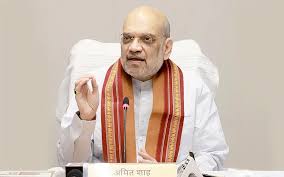
The Union Home Minister advises state leaders to concentrate on the core principles that have made the party successful, using the “Maharashtra model” as an example.
The BJP, having gained momentum after securing victories in three crucial state elections following its setback in the 2024 Lok Sabha polls, faces a significant challenge in the upcoming Bihar elections at the end of the year. The party aims to extend its dominance into the Assembly elections next year, which are expected to be a tougher test.
With the stakes high, Union Home Minister Amit Shah visited Bihar over the weekend to address public gatherings and engage in discussions with the state BJP leadership and National Democratic Alliance (NDA) allies. During his visit, he directed each of the BJP’s 84 MLAs to focus on booth management for the next six months, with the support of a party functionary. Shah emphasized the need to implement the “Maharashtra model,” which involves targeting booths that do not have a strong traditional BJP voter base. He attributed the party’s electoral successes to effective booth management and the implementation of welfare schemes under the “labharthi” strategy.
In two consecutive meetings with BJP leaders and office-bearers on March 29, Shah underscored the importance of a strong NDA alliance, mentioning Bihar Chief Minister and Janata Dal (United) chief Nitish Kumar briefly. He also stated that Prime Minister Narendra Modi would visit Bihar almost every month leading up to the Assembly elections. A BJP leader who attended the meetings noted that securing victory in Bihar is crucial, as it will set the stage for key Assembly elections in 2026, including those in West Bengal, Assam, Tamil Nadu, and Kerala.
Another senior BJP leader highlighted the party’s strategy of micro-level booth management, which involves analyzing booth-wise results and regaining voter support by ensuring the effective implementation of government welfare schemes such as Ayushman Bharat, PM Ujjwala Yojana, and PM Awas Yojana. Shah pointed out that in Maharashtra, the BJP had managed to gain additional votes in 21% of booths, helping it stage a comeback in the Assembly elections despite a drop in its Lok Sabha tally. He urged the party leadership to replicate this approach in Bihar. The home minister also emphasized the strength of the NDA’s social coalition, which he believes will provide a significant advantage in the elections.
During his visit, Shah shared the stage with Nitish Kumar at an event in Patna, where various Central and state government projects worth Rs 800 crore were launched. He later addressed a public rally in Gopalganj, where he criticized the Opposition Rashtriya Janata Dal (RJD) for what he referred to as “jungle raj” during its tenure from 1990 to 2005. Modi had also focused on the issue of law and order under the RJD’s rule in a speech in February, referring to the party only as “jungle raj waale.” Shah’s continued attack on the RJD reinforces the BJP’s campaign narrative.
In his previous visit to Bihar last month, Shah spoke about the renovation and revamp of a Sita temple in Sitamarhi, located in the Mithila region. Currently, with 84 legislators, the BJP holds the largest share of seats in the Bihar Assembly. Among its allies, the JD(U) has 45 MLAs, while the Hindustani Awam Morcha (Secular) has four representatives in the 243-member House. NDA insiders suggest that the BJP and JD(U) are considering contesting 100 seats each, leaving 43 seats for smaller allies, including the Hindustani Awam Morcha (Secular), Chirag Paswan’s Lok Janshakti Party (Ram Vilas), and Upendra Kushwaha’s Rashtriya Lok Morcha.