The DMK-led government coalition criticises the governor’s proposal to hold a conference of vice chancellors in Ooty, and the NDA camp is also concerned.
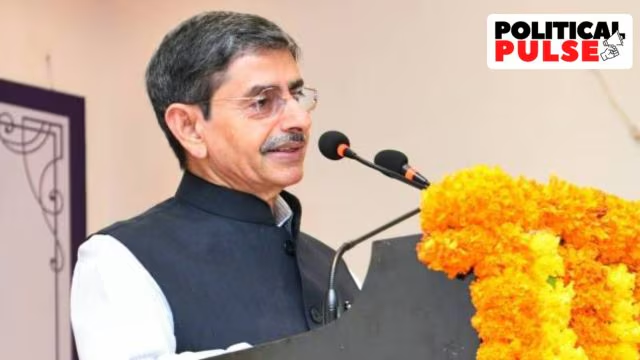
As the All India Anna Dravida Munnetra Kazhagam (AIADMK) and the Bharatiya Janata Party (BJP) work to rebuild their alliance in Tamil Nadu, they face a new challenge due to Governor R N Ravi’s decision to hold a three-day Vice-Chancellors’ conference in Ooty from April 25–27. The move has raised concerns within the National Democratic Alliance (NDA), particularly after the Supreme Court’s recent ruling that Governors cannot indefinitely delay Bills, including significant amendments to vice-chancellor appointment processes for state universities.
The Governor’s conference follows closely on the heels of a meeting convened by Chief Minister M K Stalin with state university Vice-Chancellors and registrars on April 16. Critics, including the ruling Dravida Munnetra Kazhagam (DMK)-led coalition, the Left parties, and even sections of the Rashtriya Swayamsevak Sangh (RSS) and BJP allies like the AIADMK and Pattali Makkal Katchi (PMK), view the Governor’s event as a provocative act. They fear it could be perceived as defiance of the Supreme Court’s verdict, bolstering the DMK’s narrative of federal overreach by the Centre and putting the NDA in a politically precarious position.
An RSS functionary in Tamil Nadu expressed frustration, stating, “Despite the Supreme Court upholding the state’s authority over university legislation, the Governor met Vice-President Jagdeep Dhankhar in Delhi and invited him to the Ooty conference. This counter-conference, coming right after the state’s meeting, plays into the DMK’s hands. Actions suggesting Delhi’s dominance over Tamil Nadu undermine the NDA’s credibility here.”
The Communist Party of India (Marxist) state secretary, P Shanmugam, called the Governor’s actions “contempt of the Supreme Court verdict and a violation of constitutional norms.” Similarly, R Mutharasan of the Communist Party of India labeled Vice-President Dhankhar’s potential participation as a “coordinated effort to undermine the state’s constitutional authority.”
Historically, the AIADMK and DMK have aligned on issues like state autonomy and opposition to perceived Central overreach. However, with the AIADMK now aligned with the BJP, the DMK sees an opportunity to exploit the AIADMK’s difficulty in taking clear stances on such matters, potentially weakening its position as the principal opposition party.
A Fragile NDA Alliance
A senior AIADMK leader described the Governor’s actions as a litmus test for the NDA, which is still navigating the complexities of its coalition dynamics after the AIADMK’s return. The leader emphasized that the 2026 Tamil Nadu Assembly election will hinge on electoral pragmatism rather than ideological unity, with the alliance focused on countering the DMK. “This isn’t a typical NDA; it’s an anti-DMK coalition. In 2021, Edappadi Palaniswami (EPS) was in the NDA, while T T V Dhinakaran was out. In 2024, Dhinakaran was in, and EPS was out. Now both are in, and the BJP is even courting Naam Tamilar Katchi’s Seeman, despite his criticism of PM Modi. The Governor’s actions risk derailing this strategy,” the leader said.
The AIADMK aims to reassert itself as the NDA’s anchor in Tamil Nadu, planning to contest 150–160 of the 234 Assembly seats, with the remaining seats allocated to allies. However, the Governor’s conference threatens to complicate the alliance’s efforts to present a united front against the DMK while balancing the sensitive issue of state autonomy.